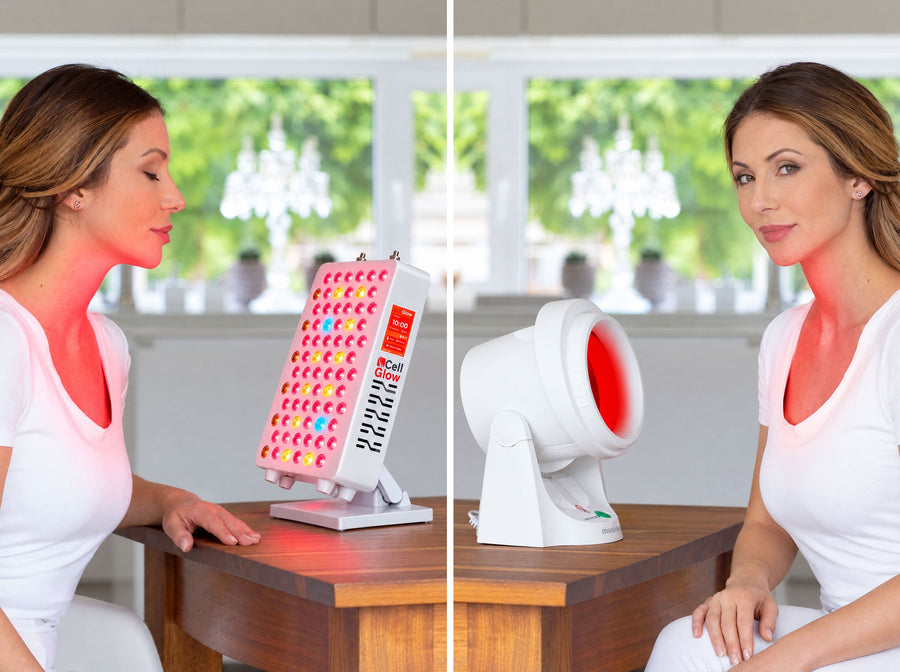
Our recommendation: if you want to expose both skin and larger body areas, choose a Cell Glow panel with separately adjustable red and NIR. Red is a sensible option for skin; NIR can travel relatively further through tissue. That does not guarantee treatment of a deep organ. Compare Cell Glow panels by treatment area and practical distance.
Short answer: under comparable conditions, near-infrared (NIR) light can often travel further into tissue than visible red light. But ‘penetration depth’ is not a fixed number of millimetres or centimetres for every person and device. Light is absorbed and scattered along the way, so its amount gradually decreases.
What does penetration depth mean?
Researchers may use different thresholds to describe depth, such as the point where a certain fraction of light remains. Numbers from different studies are therefore not directly comparable. Results depend on tissue type, wavelength, beam width and distribution, irradiance and the measurement method. A computational model of skin tissue examines wavelength and beam width; measurements of 660 nm light in human tissue show that tissue thickness and experimental setup matter too.
Red versus NIR: what can we say?
Research often uses visible red wavelengths around 630–670 nm and NIR wavelengths around 810–850 nm. NIR may travel relatively further under certain conditions. That does not mean a fixed percentage reaches a fixed depth, or that a lamp automatically treats a deep organ or joint. Even when light can be measured deeper in tissue, an effect in people must be studied separately.
Why does dose matter?
In photobiomodulation, irradiance at the target, distance and exposure time matter alongside wavelength. The review by Huang and colleagues discusses a dose-response relationship: more light does not automatically lead to a better result. Compare device measurements at the same distance and settings. Nominal LED chip power is not a measurement of the irradiance reaching your skin.
What does this mean when choosing a device?
- Check which red and NIR wavelengths the device actually emits.
- Ask for irradiance measured at a stated use distance and for the measurement method.
- Look at research for the outcome you seek; detecting light in tissue does not prove clinical benefit.
- For a medical complaint, seek professional assessment instead of buying a device on a promise of ‘deep action’.
For the difference between a red/NIR LED panel and an infrared heat lamp, read our practical comparison of red light, NIR and heat lamps. To compare red and NIR within a panel, see Red or near-infrared light: which should you choose?
Sources
- Ash et al. (2017): wavelength, beam width and light penetration (computational model).
- Hu et al. (2019): measurements of 660 nm light in human tissue.
- Huang et al. (2011): dose response in light therapy.
This article describes research on light transport and photobiomodulation. The devices and protocols studied are not necessarily equivalent to a Cell Glow product. This is not personal medical advice.