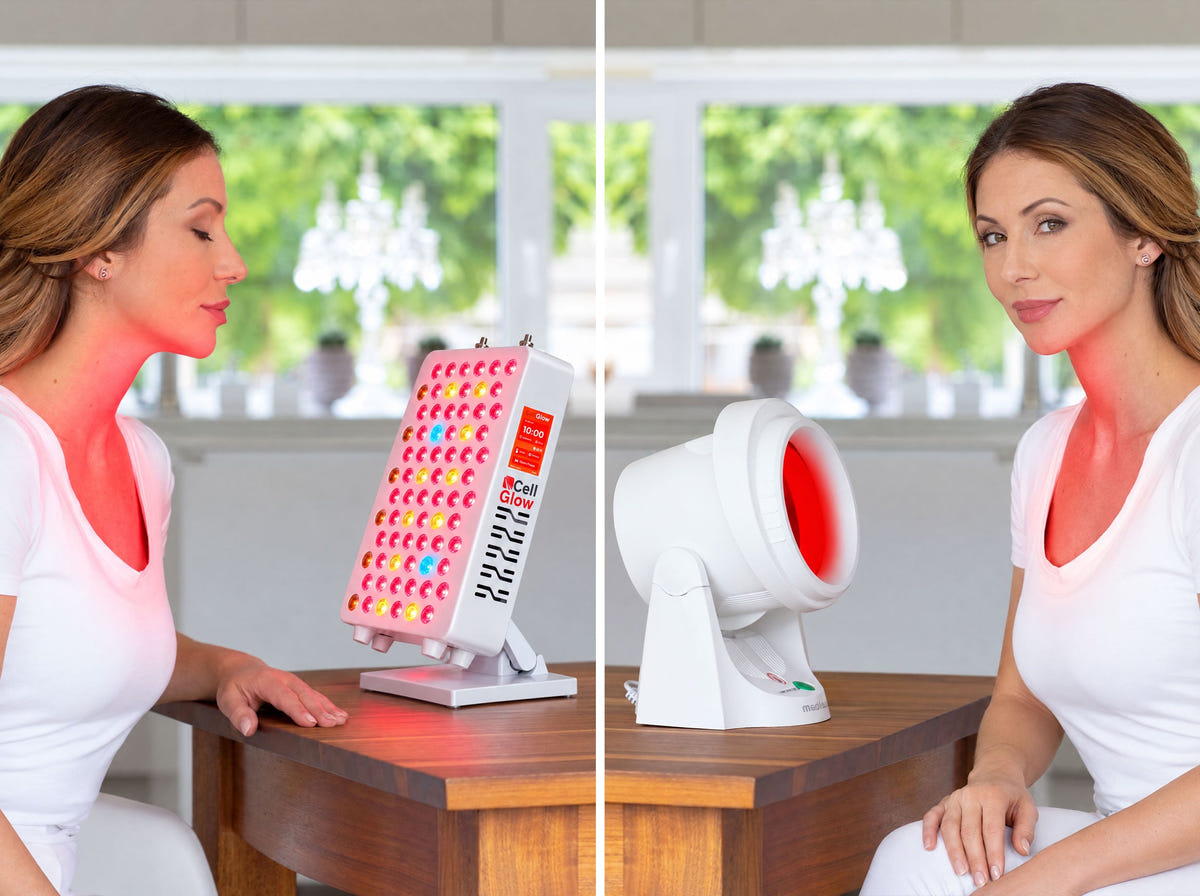
Our recommendation: if you want more than warmth, choose a red light therapy panel with both red and near-infrared (NIR) light. It lets you set up targeted light sessions with different wavelengths. If your only aim is temporary relief from muscle stiffness through warmth, an infrared heat lamp may be enough. For a recent injury that is hot or swollen, adding heat is often a poor choice. Neither device replaces assessment or treatment by a healthcare professional.
What is the difference between an RLT panel and an infrared heat lamp?
An RLT panel uses LEDs with stated wavelengths. Visible red light is often around 630–670 nm; invisible NIR is commonly around 810–850 nm. NIR is infrared: under the ICNIRP classification, infrared starts at roughly 780 nm. The key distinction is the purpose of the device. With RLT you choose a defined light exposure; with a heat lamp you primarily choose perceptible radiant warmth. An LED panel may also get warm, but warmth does not tell you the light dose.
The word “infrared” on a label does not reveal the wavelength, intensity or dose. Do not assume that a heat lamp delivers the same exposure as a panel emitting, for example, 660 and 850 nm.
Which should you choose for your goal?
- You mainly want warmth for stiff muscles, without a recent swelling: choose a heat lamp if warmth gives you relief. This is a choice for comfort; it does not automatically provide a studied RLT dose.
- You want to use light specifically for skin or hair: choose RLT. Clinical photobiomodulation research exists for selected skin and hair outcomes. A 2025 clinical consensus includes androgenetic hair loss and specific wound applications. That does not mean every home panel produces the same results.
- You also want to explore options for muscles or joints without deliberately heating them: choose a red/NIR panel over a heat lamp. NIR is used in various research protocols. An umbrella review of clinical trials found signals for some outcomes, including disability related to knee osteoarthritis, but rated the evidence for most studied outcomes as low or very low certainty. Do not expect guaranteed pain relief.
- You want one device for several types of light session: choose an adjustable red/NIR panel. You can select red, NIR or a combination, and match the intensity, distance and treatment area to your purpose. A heat lamp mainly serves one purpose: warmth.
- You have a new swollen injury, an infection, a wound that is healing poorly or unexplained symptoms: have the condition assessed first. Do not apply heat on your own initiative, and do not assume RLT is automatically a safe replacement.
When is heat a poor choice?
Heat can feel good for muscle stiffness, but it does not suit every situation. NHS guidance on heat and ice advises against heat for a new injury because it may worsen symptoms. Another NHS patient guide advises avoiding heat while inflammation and swelling are developing. There are exceptions, such as some new back strains with muscle spasm, so the nature of the problem matters.
Do not use a heat lamp without professional advice on an area with reduced temperature sensation, poor circulation, broken skin or an infection. One risk is failing to notice a burn or worsening symptoms in time. NHS heat safety advice identifies open wounds, impaired sensation and poor circulation; other NHS advice also mentions infection. RLT's lesser focus on perceptible heat does not make it a self-prescribed treatment for these problems.
Why does RLT offer more options?
A heat lamp mainly answers one question: does warmth help me relax now? A red/NIR panel lets you ask another: what light exposure do I want, and what does research say about my goal? Red and NIR can be used separately or together, while panel size determines whether you illuminate a small or larger body area. Cell Glow Custom panels offer individually adjustable wavelengths and several sizes.
This flexibility is a reason to choose RLT when your interests extend beyond warmth. It is not proof that more wavelengths, a larger panel or a higher dose always work better. Photobiomodulation research covers skin, hair, wound care and selected pain and function outcomes, but results depend on the condition, device and protocol. Medical uses such as wound care belong with a healthcare professional and cannot simply be transferred to home use.
What should you check before buying an RLT panel?
- Wavelengths: check which red and NIR wavelengths the device emits and whether you can select them separately.
- Measured output: look for a light intensity measurement at a stated distance. Nominal LED power does not tell you what reaches the skin.
- Treatment area: choose a size that fits the area you want to illuminate; a larger panel is mainly more convenient for a larger area.
- Use and safety: follow the device instructions for distance, duration and eye protection. More light or longer sessions are not automatically better; the dose-response literature explains why dose matters.
Want to compare the models? See the Custom panels or ask us which size suits your intended use. If you have a medical condition, discuss with a healthcare professional whether light therapy is suitable first.
Frequently asked questions
Is an infrared heat lamp the same as NIR light therapy?
No. NIR is part of the infrared spectrum, but a heat lamp is usually chosen for warmth. Without a specified spectrum and measurements, you cannot assume it provides the same exposure as an RLT panel.
Is RLT always better than heat?
No. Warmth may be exactly what you want for temporary relief from stiff muscles. If you want targeted red and NIR light or several light-based options, RLT is the clearer choice. With new swelling or another medical concern, assessment comes before choosing a lamp.
Is NIR automatically better for deep muscles?
No. NIR can penetrate relatively farther into tissue under some conditions, but that does not prove an effect on a deep muscle or joint. Dose, tissue and the tested protocol matter. Read our guide to light penetration.
Can I use RLT instead of heat for a recent injury?
Do not assume so. Avoid heat for a recent swollen injury, and have the injury assessed if symptoms are severe, worsening or unclear. Whether RLT is suitable and safe depends on the diagnosis and protocol.
Sources and further reading
- Red or near-infrared light: which should you choose?
- How deeply do red and NIR light penetrate?
- Consensus on clinical photobiomodulation applications (2025)
- Umbrella review of clinical photobiomodulation studies (2025)
- NHS: when to avoid heat after injury
- NHS: safe use of heat and ice
This guide compares uses and research findings. It does not diagnose a condition or replace individual medical advice. Devices and protocols studied in clinical settings are not automatically equivalent to Cell Glow panels.