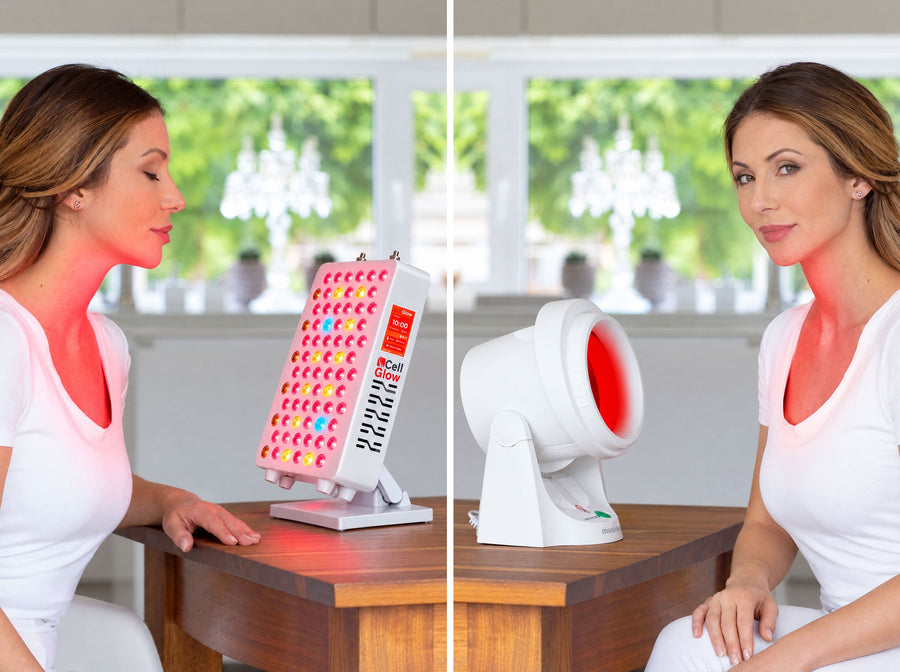
Cell Glow recommends: Choose visible red light when you mainly want to illuminate a superficial area; include NIR when you want an invisible wavelength that can reach relatively farther under some conditions. A Cell Glow Custom panel lets you use red and NIR separately or together, giving one device more options.
What changes physically?
Wavelengths are absorbed and scattered differently by skin, blood and other tissues. A commonly used red wavelength is around 660 nm; NIR devices often use values around 810 to 850 nm. The amount of light at a deeper point decreases and varies per body and device. So there is no universal 'penetration depth' in centimeters.
Why do some panels have both?
A combination can serve multiple zones and research protocols. However, more wavelengths are no guarantee of better results. The purpose, the distribution of light, the dose and the ease of use remain relevant. See if the channels can be controlled separately if you want to set up a specific session.
How do you choose?
Start with the question you want to answer and look for research that has measured that outcome in people. Then choose a device with clear specifications and a feasible protocol. For an unclear or medical complaint, a professional assessment is more important than guessing on a wavelength.
Read also
- Wavelengths in red light therapy
- How deeply do red and near-infrared light penetrate?
- Red light panel or infrared heat lamp: what is the difference?
Sources and review
- Review of the nonlinear dose response in photobiomodulation
- Scientific consensus on clinical applications of photobiomodulation
Content reviewed on 8 October 2026. The devices and protocols studied are not necessarily identical to Cell Glow products. This article is not a substitute for individual medical advice.